Brazil revises environmental assessment rules for oil and gas block offerings
| In summary Interministerial Directive 5/2026, issued on 9 November 2026 by the Ministry of Mines and Energy (MME) and the Ministry of the Environment and Climate Change (MMA), replaces the earlier rules dating from 2012 for the Environmental Assessment of Sedimentary Areas (AAAS): areas will now be classified as suitable or unsuitable, the moratorium category has been eliminated, and new deadlines and a streamlined decision-making process apply. In ADPF 825 and ADPF 887, the Brazilian Supreme Court upheld the Joint Determination as an alternative to the AAAS, but decisions on Brazil's 12th Bidding Round show that courts may still review the quality of the underlying studies and the grounds for the administrative decision. Neither mechanism authorizes specific projects, which remain subject to environmental licensing. |
Brazil has revised the environmental assessment process used to determine which areas may be offered for oil and gas exploration and production.
The Environmental Assessment of Sedimentary Areas (Avaliação Ambiental de Área Sedimentar, or AAAS) is a strategic assessment carried out as part of the planning process for oil and gas block offerings. It is supported by an Environmental Study of Sedimentary Areas (Estudo Ambiental de Área Sedimentar, or EAAS), which assesses regional conditions and potential social and environmental impacts and risks.
The new framework, issued on 9 November 2026, is established by Interministerial Directive 5/2026 by the Ministry of Mines and Energy (MME) and the Ministry of the Environment and Climate Change (MMA), and replaces the earlier rules dating from 2012.
| Download the infographic (PDF) |
What changes?
Areas will now be classified as suitable or unsuitable
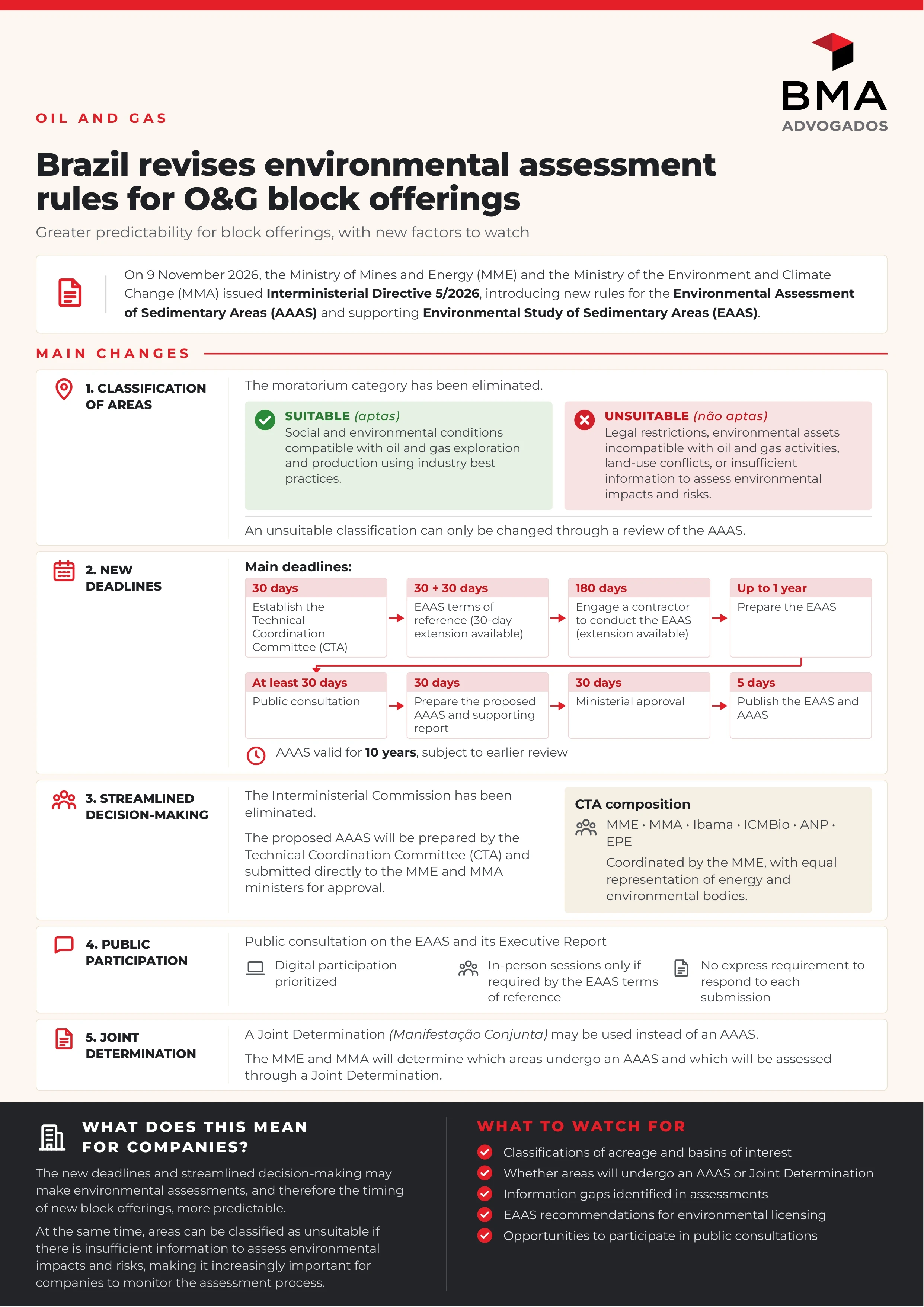
The new framework eliminates the previous moratorium category. Areas assessed under the AAAS will now be classified as either:
- suitable (aptas), where social and environmental conditions are compatible with oil and gas exploration and production; or
- unsuitable (não aptas), where there are legal restrictions, environmental assets incompatible with oil and gas activities, significant land-use conflicts, or insufficient information to assess environmental impacts and risks.
An "unsuitable" classification can only be changed through a review of the AAAS.
New deadlines apply to the assessment process
The new framework introduces deadlines throughout the assessment process, from preparation of the EAAS and public consultation through approval and publication of the final assessment and supporting study.
Deadlines for the main stages include:
- up to one year to prepare the EAAS;
- at least 30 days for public consultation;
- 30 days to prepare the proposed AAAS and supporting report;
- 30 days for ministerial approval; and
- five days following ministerial approval to publish the approved assessment and supporting study.
An AAAS will remain valid for 10 years, but may be reviewed earlier in light of new evidence or scientific or technological knowledge.
The decision-making process has been streamlined
The previous Interministerial Commission has been replaced by a Technical Coordination Committee (CTA – Comitê Técnico de Acompanhamento), with representatives from the Ministry of Mines and Energy (MME), Ministry of the Environment and Climate Change (MMA), the Brazilian Institute of the Environment and Renewable Natural Resources (Ibama), the Chico Mendes Institute for Biodiversity Conservation (ICMBio), the National Agency for Petroleum, Natural Gas and Biofuels (ANP) and the Energy Research Office (EPE).
The CTA's proposed AAAS will be submitted directly to the Ministers of Mines and Energy and the Environment and Climate Change for approval.
Public participation will move online
Public participation will take place through consultation on the EAAS and its Executive Report, with the new framework prioritizing digital participation.
An in-person consultation session in the area covered by the study will be held only if required by the terms of reference established for the EAAS.
A Joint Determination is an alternative to an AAAS
A Joint Determination (Manifestação Conjunta) by the Ministry of Mines and Energy and Ministry of the Environment and Climate Change, based on an assessment of potential environmental restrictions, is expressly recognized as an alternative to the AAAS for planning oil and gas block offerings.
The two ministries will determine which areas are subject to an AAAS and which will be assessed through a Joint Determination.
What does this mean for companies?
The new deadlines and streamlined decision-making process may make environmental assessments, and therefore the timing of new block offerings, more predictable.
At the same time, areas can be classified as unsuitable if there is insufficient information to assess environmental impacts and risks. Monitoring environmental studies and public consultations will therefore be increasingly important for companies with an interest in potential new acreage.
Companies should pay particular attention to:
- the classification of acreage and basins of interest to them;
- whether those areas will be subject to an AAAS or assessed through a Joint Determination;
- any information gaps identified in the assessment of environmental impacts and risks;
- EAAS recommendations relevant to subsequent environmental licensing; and
- opportunities to participate in public consultations.
Companies should also keep in mind that while the AAAS supports planning for block offerings and subsequent environmental studies, it does not replace project-level environmental licensing.
What have the courts said about the AAAS?
Brazilian courts have recognized the AAAS as an important part of planning oil and gas block offerings. However, their position on whether an AAAS must be completed before a bidding round has evolved.
The AAAS supports planning, not environmental licensing
The AAAS is a strategic, regional assessment that supports planning for block offerings by classifying areas as suitable or unsuitable and identifying potential social and environmental restrictions and recommendations.
It does not replace environmental licensing. The environmental viability of individual exploration and production activities is assessed separately and in greater detail during the licensing process for each project.
The Supreme Court has upheld the Joint Determination as an alternative to the AAAS
In constitutional challenges ADPF 825 and ADPF 887, the Brazilian Supreme Court (STF – Supremo Tribunal Federal) upheld the use of a Joint Determination by the Ministry of Mines and Energy and the Ministry of the Environment and Climate Change as an alternative to the AAAS when planning block offerings.
The STF found that using this alternative procedure does not, in itself, violate the precautionary principle or the principles of sustainable development and environmental protection. It also recognized that deciding which assessment mechanism to use involves highly technical policy choices that fall within the purview of the responsible administrative authorities.
Neither the AAAS nor a Joint Determination authorizes specific projects
Classifying an area as suitable under the AAAS does not bind the environmental licensing authority or guarantee that environmental licenses will be granted. Similarly, a Joint Determination does not replace the studies that may be required before exploration or production activities begin.
Both mechanisms operate at the block-offering planning stage. Individual projects remain subject to environmental licensing and any project-specific studies required before they can proceed.
The Joint Determination procedure remains subject to judicial review
Recognition of the Joint Determination as a valid alternative to the AAAS does not mean that blocks can be offered without an adequate technical basis.
In cases involving Brazil's 12th Bidding Round,* Federal Courts of Appeal looked at deficiencies in the available studies, risks associated with hydraulic fracturing, unfavorable specialist reports and the environmental sensitivity of the areas concerned. The courts found these deficiencies sufficient to annul the bidding round and the related contracts.
These decisions show that, although the Joint Determination is valid as an alternative mechanism, courts may still review the quality of the underlying studies, the grounds for the administrative decision and whether social and environmental risks were properly considered in each case.
* Cases AC/REEX 0005610-46.2013.4.01.4003 (Federal Court of Appeal for the 1st Region – TRF1) and ApRemNec 5005509-18.2014.4.04.7005 (Federal Court of Appeal for the 4th Region – TRF4)
Clear rules can reduce legal uncertainty
These decisions suggest that the main legal issue is no longer whether a Joint Determination may be used instead of an AAAS, but whether Joint Determinations are made consistently and on an adequate technical basis.
In our view, reducing legal uncertainty will require clear, objective criteria for choosing between an AAAS and a Joint Determination, including rules addressing:
- the minimum technical requirements for each mechanism;
- the responsibilities of the government bodies involved;
- how information gaps and scientific uncertainty are addressed;
- consideration of specialist reports from environmental authorities;
- requirements for reasoned decision-making, transparency and public participation; and
- how environmental restrictions and recommendations are reflected in planning for block offerings and environmental licensing.
Clear rules and a traceable technical basis for decisions can reduce the risk of legal challenges, make bidding rounds more predictable and help align energy policy with the precautionary principle and sustainable development.
BMA Advogados' Environmental Law team can assist companies in assessing the implications of the new rules and monitoring AAAS procedures, Joint Determinations and related public consultations.