
New regulations on administrative settlements under Brazil’s Anticorrupton Law
On August 29, 2024, the Office of the Federal Comptroller (“CGU” – Controladoria-Geral da União) issued Directive 155 (Portaria Normativa 155, the “Directive”), establishing new rules for administrative settlements in connection under Law 12.846/2013, Brazil’s Anticorruption Law. The administrative settlement, or termo de compromisso, replaces the earlier consent order (julgamento antecipado) created by Directive 19, issued on July 22, 2022. The new rules are intended to make room for consensual solutions, even when a leniency agreement is not possible.
At the beginning of 2024, the CGU reported that 69 requests for consent orders had been made, of which 26 were issued, resulting in the payment of penalties totaling BRL 36,119,683.15.1 The volume of consent orders is especially notable when compared to the number of leniency agreements: in less than two years, 26 consent orders were issued, while from 2017 to 2024 – seven years – 29 leniency agreements were made.
One possible explanation for the large number of consent orders in such a short period of time is that in comparison with leniency agreements consent orders are a more flexible instrument for achieving consensual solutions in less complex matters.
The Directive is part of the agenda for combating corruption announced by the Minister of the CGU to mark the Anticorruption Law’s 10th anniversary. By creating an instrument that is genuinely negotiated between the parties and involving the Office of the Advocate-General (AGU – Advocacia-Geral da União) in the negotiations, unlike (AGU) the earlier consent order, the Directive will generate greater legal certainty.
The new administrative settlement was the subject of public hearings in 2023 and does not introduce significant changes into the practice established for consent orders.
There are, however, some differences that merit attention: (i) the possibility of converting a request for a leniency agreement into an administrative settlement, and (ii) suspension of the limitation period during negotiations, for up to 360 days.
To foster compliance and integrity in companies, the Directive also provides that, depending on the circumstances of each case, administrative settlements may be made conditional on the adopting, applying, or improving a corporate compliance and integrity program.
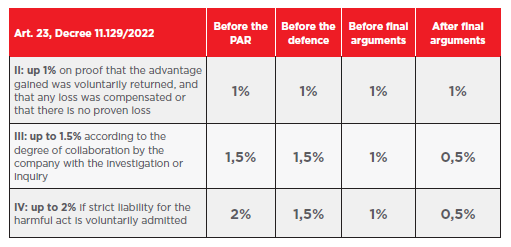
The Directive maintains the benefit of a simple fine (without publication of administrative decision finding the company liable for corruption), and the attenuation percentages under article 23 of Decree 11.129/2022. The percentages that apply to attenuate the fine vary according to the stage at which an administrative settlement is proposed, which is possible at any time before judgment of the administrative liability proceeding (PAR – processo administrativo de responsabilização):
As for the harmful conduct that may result in restrictions on the offending company's ability to participate in competitive procurement processes and other government contracts, the Directive fills in earlier gaps and provides that the length or scope of the restriction may be reduced, although there is a minimum of 60 days for any exclusion or suspension.
Under the Directive, "avocation", which refers to the CGU's authority to review administrative proceedings and investigations, is largely unchanged in comparison to what was already being carried out by the authority, although the Directive adds greater certainty to the procedure by expressly providing that the original proceeding is stayed pending the CGU's decision whether to assume jurisdiction, and allowing the time periods to be returned if the if the investigation of the facts is reinitiated.
Last, the Directive provides for the consequences of failure to comply with the terms of administrative settlements, which accelerated maturity of all installments payable under the agreement, and a three-year ban on any new administrative settlement with CGU.
>>> This content is part of BMA Review #85. Click here for more.
NOTE
1 Available at