
A Shorter Workweek for Brazil
| At a Glance Constitutional Amendment 141, promulgated on 16 October 2026, ends Brazil's six-day workweek and reduces the maximum weekly hours from 44 to 40, with no reduction in pay. The change comes in two stages. Starting 16 December 2026, the limit falls to 42 hours, employees are entitled to two paid rest days a week, and conflicting collective agreement provisions cease to apply. From 16 December 2027, the limit falls to 40 hours. Employers should act now: map current schedules, model costs and open negotiations with unions. |
In many jurisdictions, working hours are set by ordinary legislation. In Brazil, they are a constitutional matter: Article 7 of the Constitution sets out workers' protected rights, establishing minimum standards for the essential terms of employment. Its limits of eight hours a day and 44 a week, with one paid weekly rest day, had stood since 1988; the amendment replacing them, first proposed in December 2019, took almost seven years to pass. Because the new limits are constitutional, they prevail over less favorable terms in employment contracts and, except where the Constitution allows, collective agreements. Any further change would require another amendment, passed by a three-fifths majority in two votes in each house of Congress.
The infographic below summarizes the new rules, the transition and pay protections, key dates, points to watch and a checklist of first steps for employers. Our Labor and Employment team can help you adapt your operations to the new rules. To discuss how the changes affect your business, contact us.
Download the PDF or read the whole content below.
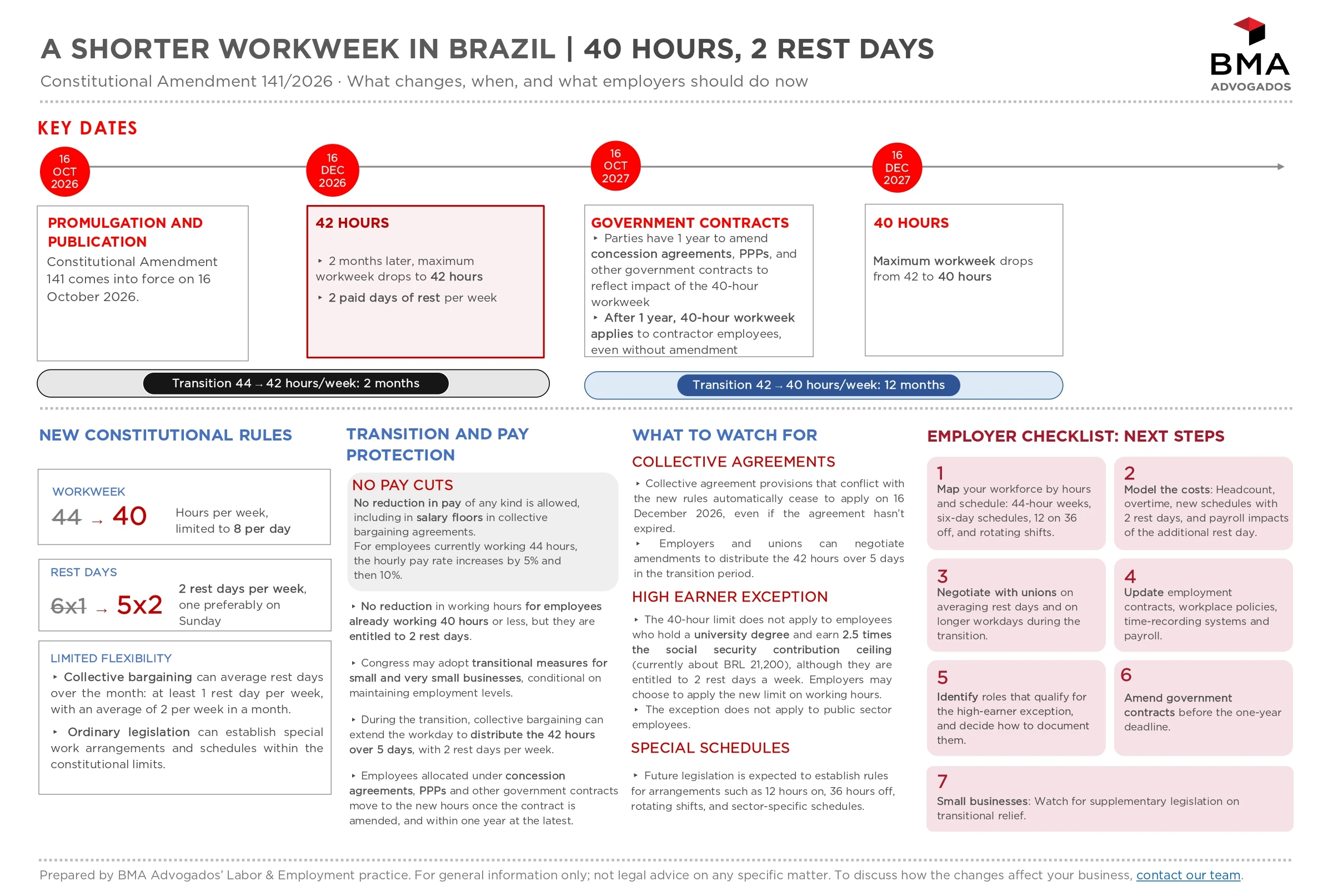
Key dates
- 16 Oct 2026 · Promulgation and publication
Constitutional Amendment 141 comes into force on 16 October 2026. - 16 Dec 2026 · 42 hours
Transition 44 → 42 hours/week: 2 months- 2 months later, maximum workweek drops to 42 hours
- 2 paid days of rest per week
- 16 Oct 2027 · Government contracts
- Parties have 1 year to amend concession agreements, PPPs, and other government contracts to reflect impact of the 40-hour workweek
- After 1 year, 40-hour workweek applies to contractor employees, even without amendment
- 16 Dec 2027 · 40 hours
Transition 42 → 40 hours/week: 12 months
Maximum workweek drops from 42 to 40 hours
New constitutional rules
Workweek
44 → 40 hours per week, limited to 8 per day
Rest days
6x1 → 5x2
2 rest days per week, one preferably on Sunday
Limited flexibility
- Collective bargaining can average rest days over the month: at least 1 rest day per week, with an average of 2 per week in a month.
- Ordinary legislation can establish special work arrangements and schedules within the constitutional limits.
Transition and pay protection
No pay cuts
No reduction in pay of any kind is allowed, including in salary floors in collective bargaining agreements. For employees currently working 44 hours, the hourly pay rate increases by 5% and then 10%.
- No reduction in working hours for employees already working 40 hours or less, but they are entitled to 2 rest days.
- Congress may adopt transitional measures for small and very small businesses, conditional on maintaining employment levels.
- During the transition, collective bargaining can extend the workday to distribute the 42 hours over 5 days, with 2 rest days per week.
- Employees allocated under concession agreements, PPPs and other government contracts move to the new hours once the contract is amended, and within one year at the latest.
What to watch for
Collective agreements
- Collective agreement provisions that conflict with the new rules automatically cease to apply on 16 December 2026, even if the agreement hasn't expired.
- Employers and unions can negotiate amendments to distribute the 42 hours over 5 days in the transition period.
High earner exception
- The 40-hour limit does not apply to employees who hold a university degree and earn 2.5 times the social security contribution ceiling (currently about BRL 21,200), although they are entitled to 2 rest days a week. Employers may choose to apply the new limit on working hours.
- The exception does not apply to public sector employees.
Special schedules
- Future legislation is expected to establish rules for arrangements such as 12 hours on, 36 hours off, rotating shifts, and sector-specific schedules.
Employer checklist: next steps
- 1 Map your workforce by hours and schedule: 44-hour weeks, six-day schedules, 12 on 36 off, and rotating shifts.
- 2 Model the costs: Headcount, overtime, new schedules with 2 rest days, and payroll impacts of the additional rest day.
- 3 Negotiate with unions on averaging rest days and on longer workdays during the transition.
- 4 Update employment contracts, workplace policies, time-recording systems and payroll.
- 5 Identify roles that qualify for the high-earner exception, and decide how to document them.
- 6 Amend government contracts before the one-year deadline.
- 7 Small businesses: Watch for supplementary legislation on transitional relief.
Key questions
When do the changes take effect?
Constitutional Amendment 141 came into force on 16 October 2026. The first changes to working hours and rest days apply from 16 December 2026, two months later.
What is the timetable for moving to a 40-hour week?
The reduction happens in two stages:
- 16 December 2026: the maximum workweek drops from 44 to 42 hours.
- 16 December 2027: the maximum workweek drops from 42 to 40 hours.
What changes on 16 December 2026?
The maximum workweek drops to 42 hours, and employees become entitled to two paid rest days a week. This ends the six-day schedule known in Brazil as "6x1." Collective agreement provisions that conflict with the new rules cease to apply on the same date.
Can employers reduce pay to reflect the shorter workweek?
No. Pay cannot be reduced in any way, including in proportion to the shorter hours. Salary floors in collective agreements are also protected.
What happens to collective agreements that conflict with the new rules?
Conflicting provisions automatically cease to apply on 16 December 2026, even if the agreement hasn't expired. During the transition, employers and unions can negotiate a longer workday so that the 42 hours can be worked over five days, with two rest days a week.
Which employees are not covered by the working-hour rules?
Working-hour limits and time-recording rules do not apply to employees who hold a university degree and earn at least 2.5 times the social security contribution ceiling (currently about BRL 21,200 a month), but these employees are entitled to two rest days a week. Employers can still choose to apply the new limits, and collective agreements may require them. The exception does not apply to public-sector employees.
What about 12-hour shifts, rotating shifts and sector-specific schedules?
Future legislation is expected to establish rules for arrangements such as 12x36 schedules (12 hours on, 36 off), rotating shifts, and sector-specific schedules, within the constitutional limits. No such legislation exists yet.
Do companies with government contracts have a different deadline?
Yes. The parties have until 16 October 2027 to amend concession agreements, PPPs and other government contracts to reflect the impact of the 40-hour workweek. Employees assigned to these contracts move to the new hours once the contract is amended. After 16 October 2027, the 40-hour workweek applies to them even if the contract has not been amended.
BMA Advogados is one of Brazil's leading full-service law firms, advising companies and investors on the market's most significant and sophisticated transactions.
This material was prepared by BMA Advogados' Labor and Employment practice for general information only and does not constitute legal advice on any specific matter. Questions? Contact our team.