
Limits on Tax Penalties: From the Supreme Federal Court to the National Congress
Limiting Brazil’s (very high) tax fines is not new issue, but it has now caught the attention of National Congress. Recent developments include:
- Approval of Bill PL 2384/2023, reducing the assessment penalty from 150% to 100% in cases of fraud, evasion, or collusion. The reduction will retroactive effect, by virtue of article 106 of the National Tax Code;
- Presidential vetoes of provisions under Law 14.689/2023 (formerly Bill PL 2384/2023) which reduced assessment penalties by at least one-third and late-payment penalties by at least 50%, and limited assessment penalties to 100% of the tax assessed, even for tax debts subject to collection through the courts have returned to the Chamber of Deputies1 and may be overturned;
- Approval of Bill PL 4287/2023 in the Senate, which proposes to reduce federal assessment penalties from 75% to 50% of the tax assessed. While Law 14.689/2203 may have minimized or even surpassed a binding ruling (known as Temas or “Themes”) by Brazil’s highest court, the Supreme Federal Tribunal (STF – Supremo Tribunal Federal), on doubled assessment penalties in cases of fraud, evasion, or collusion (Theme 863), it did not resolve two other significant issues (Theme 1195 – assessment penalties exceeding 100% of the tax assessed, and Theme 816 – late payment fines exceeding 20%), due to presidential vetoes.
Brazil’s disproportionate tax fines have long been the subject of disputes before the courts. There are various types of fines (late-payment penalties, assessment penalties and penalties for failing to comply with accessory obligations) and often they apply cumulatively. Many fines exceed the amount of tax owed, and are disproportionate to the infraction committed, triggering premature criminal complaints by the tax authorities and successive investigations, all of which makes providing security for tax debts even more burdensome and borders on true confiscation.
The Brazilian Constitution establishes the principles of non-confiscation, proportionality, and the taxpayer’s ability to pay, establishing an objective limit on fines – which are, after all, a tool to encourage compliance with tax obligations, rather than a “back door” means of generating revenue for the public coffers.
In a leading case, the STF held that “the constitutional prohibition against confiscation in tax matters is nothing less than the Carta Magna’s interdiction of any attempt by government that may lead, in the field of taxation, … to the unjust appropriation by the state of taxpayers’ property or income, in whole or in part ….”2
In fact, the constitutional limits on tax fines is the subject of four “themes of general repercussion”, which means that the STF’s ruling will bind all lower courts and administrative instances. The “themes” or issues to be decided are:
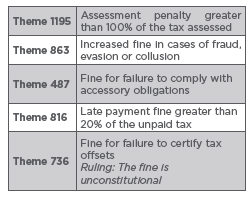
All these issues involve, essentially, the limit between the state’s powers of taxation and taxpayers’ fundamental right to property.
The STF’s ruling on these issues is much needed, especially at the state and municipal level. Historically, the states and municipalities have imposed cumulative fines that disregard both the principle that the greater offense includes the lesser and the amount of tax effectively owed. The problem is illustrated by the case associated with Theme 1195, in which the punitive fines imposed reach the absurd heights of 400% of the amount of tax in dispute (ICMS), even in the absence of fraud, evasion or collusion.
Justice Luís Roberto Barroso, who is now President of the STF, expressed his position very clearly in an earlier judgment: “The idea that the accessory may not exceed the principal seems to be the most appropriate criterion for fixing the parameters of punitive fines, above all when one considers that the amount is equal to the tax itself.”3
After all, tax penalties should serve to promote compliance with tax obligations, not as an independent source of revenue.
Until the STF turns its attention to the tax penalty cases, National Congress seems willing to speed up the pace of legislation to establish express, objective limits on tax penalties, by means of Bill PL 4287/2023, the vetoes under Bill PL 2384/2023, and similar measures.
Whether by means of new legislation or a binding ruling by the STF, the time has come to uphold the Constitution and impose limits on tax fines, to curb “back door” revenue generation and the confiscatory effect of excessive fines.
The tax penalty scorecard: Goiás, Rio Grande do Sul, Rondônia, and the federal government
- Goiás charged a fine exceeding 120% of the amount of the tax. The STJ disallowed the fine (Appeal RE 833.1060).
- Rio Grande do Sul charged a late-payment fine of 30% of the unpaid tax, which the STF limited (Appeal ARE 727.872).
- Rondônia imposed a 40% fine on price of the transaction for mere non-compliance with ancillary obligations (invoices). The STF has not yet issued a decision, but seems to be forming a position in favor of limiting the fine (Appeal RE 640.452).
- The federal government often imposes both assessment penalties and fines for failure to comply with accessory obligations, but was recently rebuked for this practice by a unanimous decision of the Superior Court of Justice – STJ on November 7, 2023 (Appeal RESP 1.708.819).
- The federal government has been charging a 150% assessment penalty in cases of tax evasion or fraud, but the STF has promised to establish “appropriate guidelines in a ruling in a general repercussion case.”
>>> This article belongs to BMA Review 81. Click here to read more articles.
NOTES
1 Status of Bill PL 2384 and the vetos when this article was written (3 October 2023).
2 Appeal ARE 754554, Justice Celso de Mello reporting, judged 22 October 2013.
3 Appeal ARE 938538, Justice Roberto Barroso reporting, judged 30 September 2016.